
The choice is not made from a catalogue but on three figures: the volume to heat, the building’s level of insulation and the pattern of occupancy. From these follow the mass to build, the nominal output and the space required.
Checked on 31/08/2026
Three figures decide everything
A masonry heater is not chosen from a catalogue, because it is not chosen on its own: it is the house that sizes it. Three figures are enough to frame the project.
- The volume to heat — the room the heater stands in, those it reaches, the upper floor if any. A masonry heater heats what it sees and what surrounds it; it does not push air down a corridor.
- Insulation — a well-insulated house needs little energy, and a heater that gives out too much overheats. This is the case where sizing is scaled down.
- Pattern of occupancy — continuous presence or long absences, a burn morning and evening or just one a day. The pattern sets the mass: the more autonomy you want between two fires, the more material you need.
From these three figures follow the mass to build, the output, the floor space and the weight. Everything else — shape, cladding, options — comes afterwards.
Reading kW and kWh without getting them mixed up
Appliance data sheets show an output, in kilowatts (kW). An output is a rate of heat at a given moment. What a house needs is a quantity of energy over the day, in kilowatt-hours (kWh). Comparing heaters on output alone is comparing rates without looking at duration.
An example, in round figures. A well-insulated house needs 48 kWh of heating a day. A convection stove, which only heats while the fire is burning, has to deliver those 48 kWh in five hours of burning: it needs close to 10 kW. A masonry heater releases the same 48 kWh over twenty-four hours: that is 2 kW on average, without interruption. The second looks ‘less powerful’; it gives out the same energy, and gives it out when the house needs it.
That is why a masonry heater is sized on the energy released per day, not on the nominal output of a firebox. The design calculation (NF EN 15544) does exactly that.
Efficiency: what the figure says, and what it does not
Efficiency measures the share of the wood’s energy that the appliance turns into heat during combustion. It says nothing about what becomes of that heat afterwards — blown into the room while the fire burns, or stored in the mass. Two heaters of equal efficiency can therefore heat a house very differently.
Efficiency is largely in your hands: dry wood (two years under a ventilated shelter, split), a brisk fire rather than a smothered one, a sufficient air supply. Damp wood spends its energy boiling off its water; a damped-down fire sends its unburnt gases up the flue. The best firebox can do nothing about that.
Space, floor and flue
A masonry heater weighs from one to several tonnes. On a slab, it simply sits; on a suspended floor, the load path is checked and calculated before any drawing is made. It needs its floor space, safety clearances from the building’s timbers, and access to the cleaning doors.
The flue is its engine: it is what creates the draught. It is calculated together with the appliance (NF EN 13384-1), and the flue is restored or built before the heater is constructed, never after. In an airtight house, an external combustion air supply feeds the firebox.
The shape comes afterwards
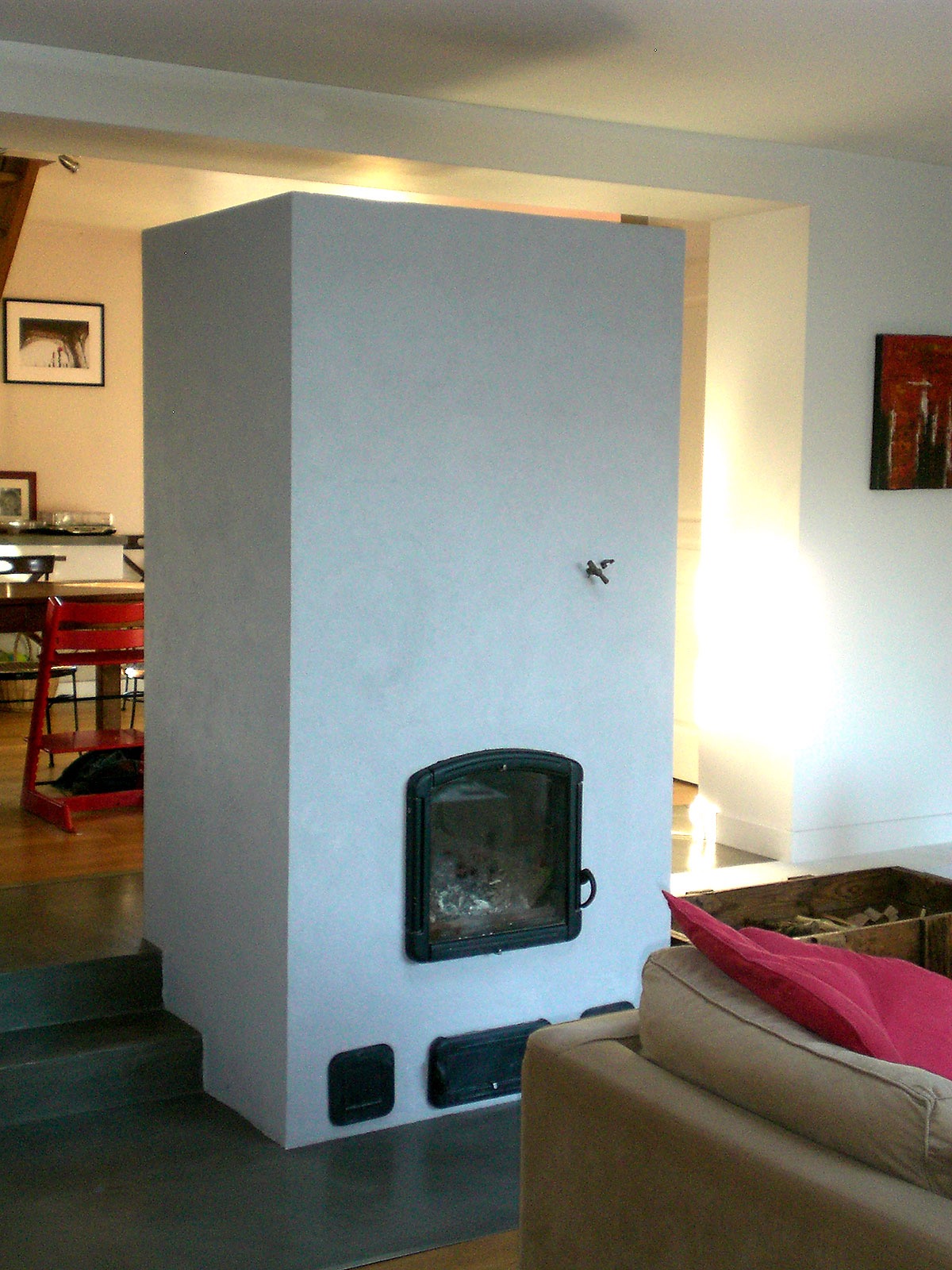
Once the mass and output are set, the heater takes the shape of the house: central, against a wall, see-through between two rooms, with or without a heated bench, oven or log niche. The cladding — render, stove tiles, stone, brick — is chosen last, and it is what you see. Our projects show what that looks like, project by project.
Lead time
Allow three months at the very least between signing and the first fire, six to eight months on average, longer for a complex project or when the flue has to be built. The calculation, the drawing, workshop preparation and the drying of the masonry each take their time.
What we check at the study stage
Volume, insulation, occupancy, floor, flue, air supply: your project study gathers these figures in one go. It ends in a design calculation and a costing, not a heater chosen from a photo.
Key point — Real output, thermal inertia, siting, flue: choosing a heat-storage stove well means first reading your house well.
Page reviewed on 31/08/2026 by Thermasse — stove builder and founding member of the AFPMA. These general principles of the site-built masonry heater are made specific, with figures to back them up, during your project study.