
We distinguish the fully site-built masonry heater, built brick by brick on site; the heat-storage stove, assembled around an industrial firebox; the masonry cooker, which cooks as much as it heats; and the kit heater, intended for supported self-build.
Checked on 31/08/2026
Three families, one principle
All these appliances store the heat of a short fire in a mass and release it afterwards. What sets them apart is the share of heat that goes through the mass and the share given off straight away, during the fire. From this split follow the thermal inertia, the responsiveness, the instantaneous output — and the use each family is suited to.
The masonry heater: the full mass
This is the fully site-built appliance: a firebox in firebricks, or a cast-iron firebox without convection grilles, and a ceramic accumulator. No heat is blown out during the fire; everything goes through the mass, which then radiates for twelve to twenty-four hours, sometimes more. It is the family with the greatest thermal inertia, and the simplest to run: one to two burns a day.
Its traditional forms are many: the Grundofen in rendered brick, the Kachelofen clad in stove tiles, the Finnish brick stoves with contraflow draught, the Russian, Polish, Romanian and Swedish site-built stoves. The cladding — render, stove tiles, stone, exposed brick — is chosen to suit the house; the calculation is the same.
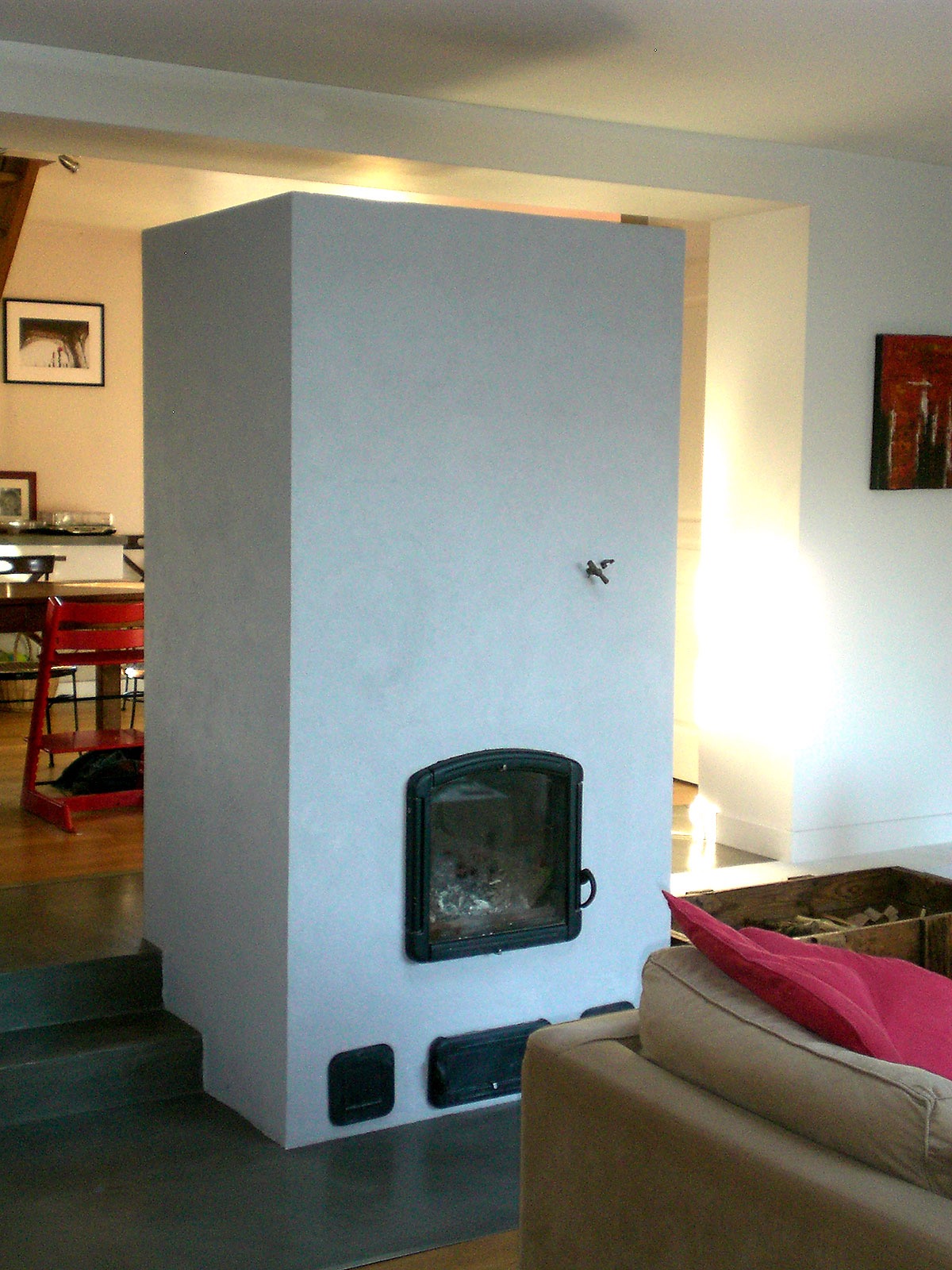
The heat-storage stove: a manufacturer’s firebox and its mass
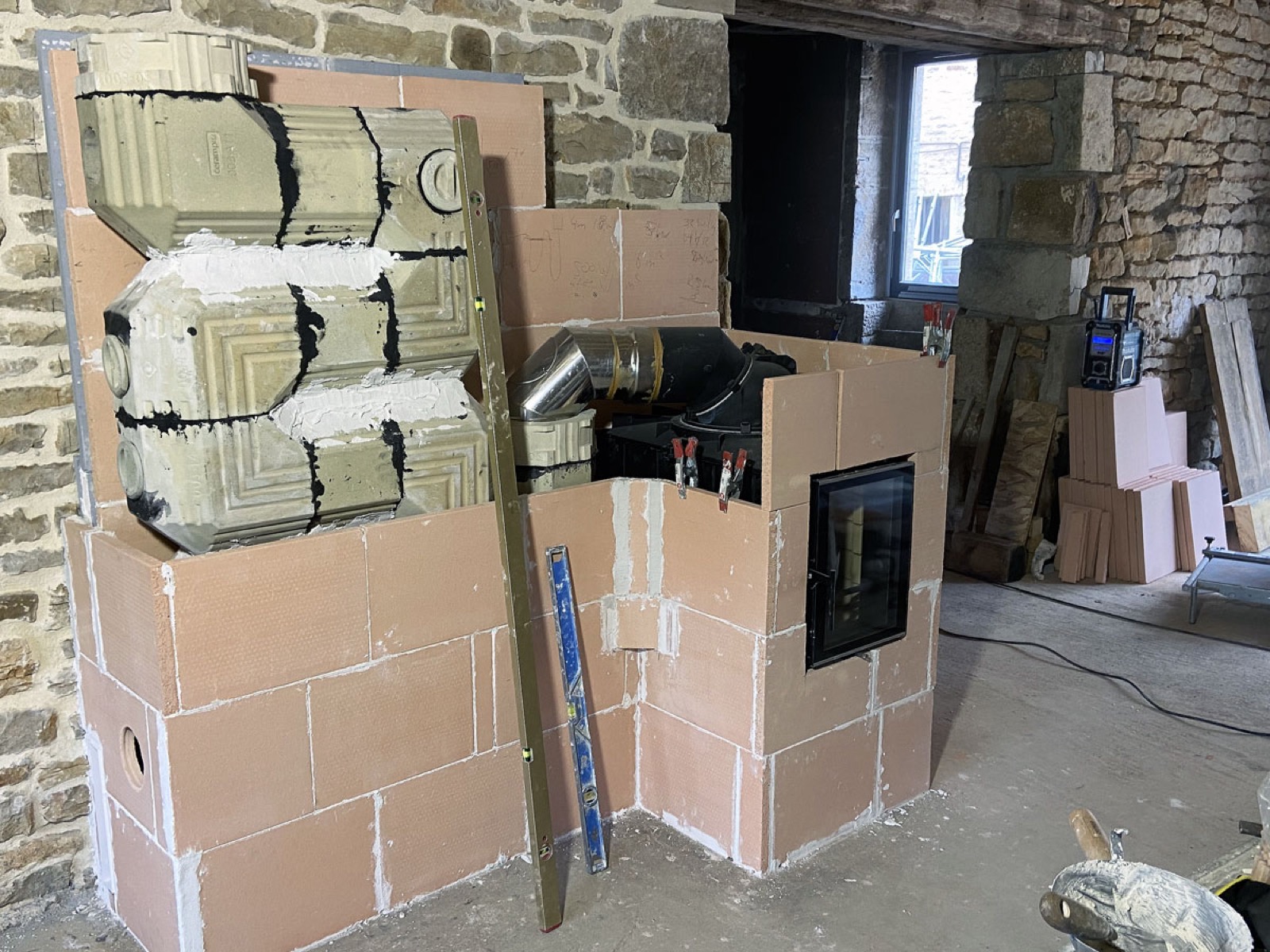
Also called a Kombiofen, semi-mass or half-mass heater, it is built around a manufacturer’s cast-iron firebox fitted with convection grilles, combined with a ceramic or cast-iron accumulator. During the burn, part of the heat is given to the room by convection; the rest is stored and released afterwards.
The balance between the two is chosen at the design stage, depending on what you expect: more responsiveness while the fire burns, or more inertia afterwards. This is the family of the Brunner and Ortner fireboxes found on a good share of our projects, and the one that accepts electronic control of the air supply.
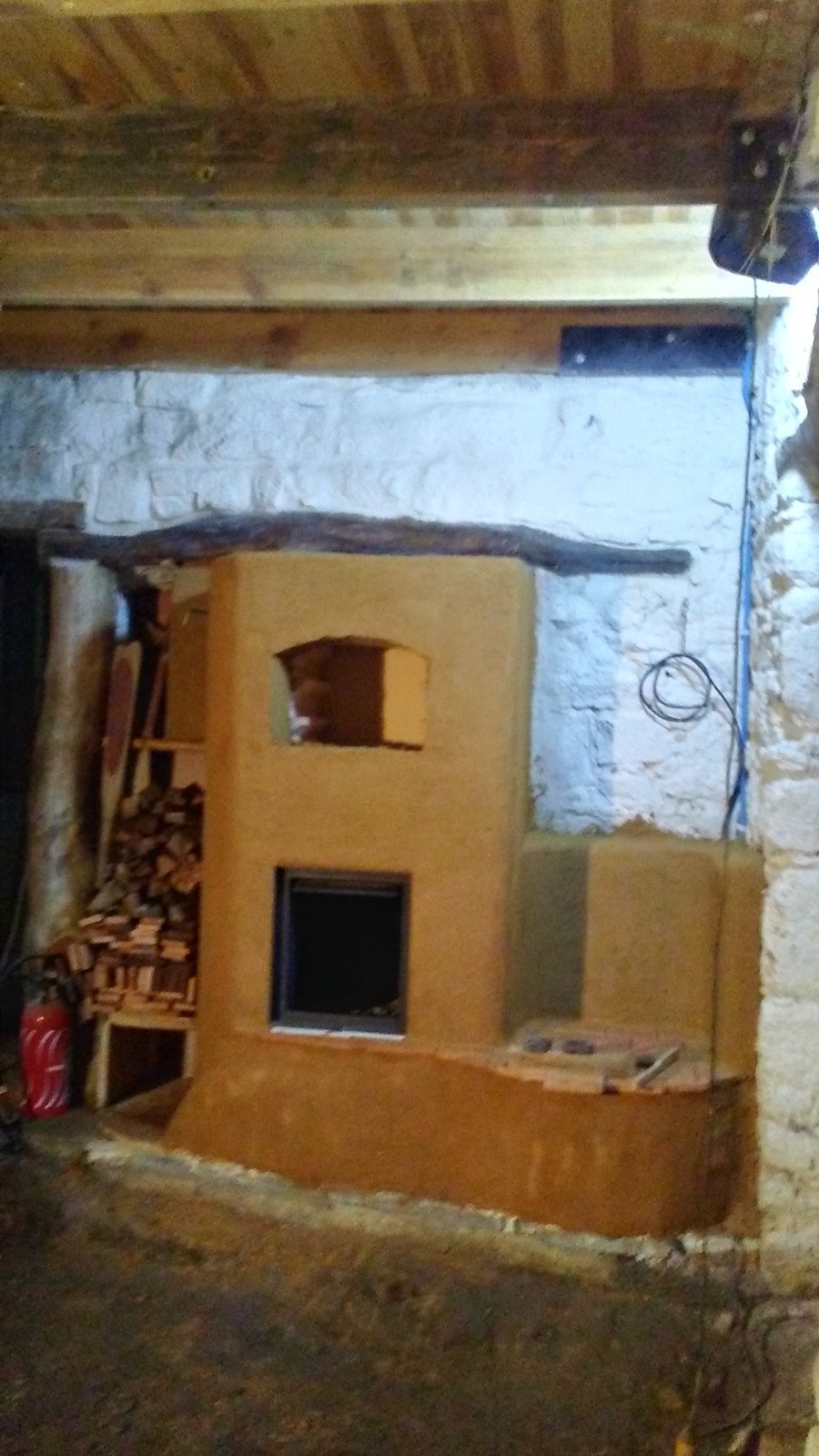
The masonry cooker: cook first, heat second
The masonry cooker is site-built too, and holds heat for several hours. But its first role is cooking, and everything follows from that: a smaller firebox, a hotplate that gives off heat immediately — it provides the convection, in place of grilles — and so more instantaneous output and less inertia than a masonry heater. It is run somewhere between an intermittent fire and a continuous one: three fires a day, kept going for as long as the cooking takes.
It is found as a Finnish masonry kit, in the Austrian ‘Herde’, and in the combined cookers of Eastern Europe with several fireboxes and one or more hotplates. An oven, a bench or a boiler can be added.
And kits?
A kit is not a family: it is a form of supply. The Finnish Tiileri kits we distribute are masonry heaters or masonry cookers delivered as pre-cut elements, to be built in masonry on site — by you, with support, or by an installer from the network. The self-build page presents the models and the support.
Choosing between the three
| Masonry heater | Heat-storage stove | Masonry cooker | |
|---|---|---|---|
| Thermal inertia | the greatest | high, adjustable at the design stage | several hours |
| Heat during the fire | almost none | partial, by convection | through the hotplate |
| Running | one to two burns a day | one to two burns a day | three fires a day, kept going while cooking |
| Who it suits | a house occupied all day, for constant comfort | a house that also wants quick heat | wood-fired cooking first, heating second |
In every case, the house decides — volume, insulation, pattern of occupation — and the study of your project settles it.
Where these families come from
Site-built heat-storage heaters were born in the cold countries of Europe: Austria and Germany for the tiled Kachelofen and the Grundofen; Finland, Sweden and Russia for the contraflow stoves; Alsace for the French tradition. Masonry cookers followed the same path, from farms to towns. Today’s appliances take up these principles with a standardised calculation (NF EN 15544) and glazed fireboxes.
Key point — Site-built masonry heater, heat-storage stove, masonry cooker: three families, one principle of heat storage — the right choice depends on the house and how it is used.
Page reviewed on 31/08/2026 by Thermasse — stove builder and founding member of the AFPMA. These general principles of the site-built masonry heater are set out in detail, with figures, during the study of your project.