A masonry heater is heat-storage wood heating: one short, lively burn whose energy is stored in refractory masonry — brick, stone, grog — before being released as radiant heat, gently, for hours or even days.
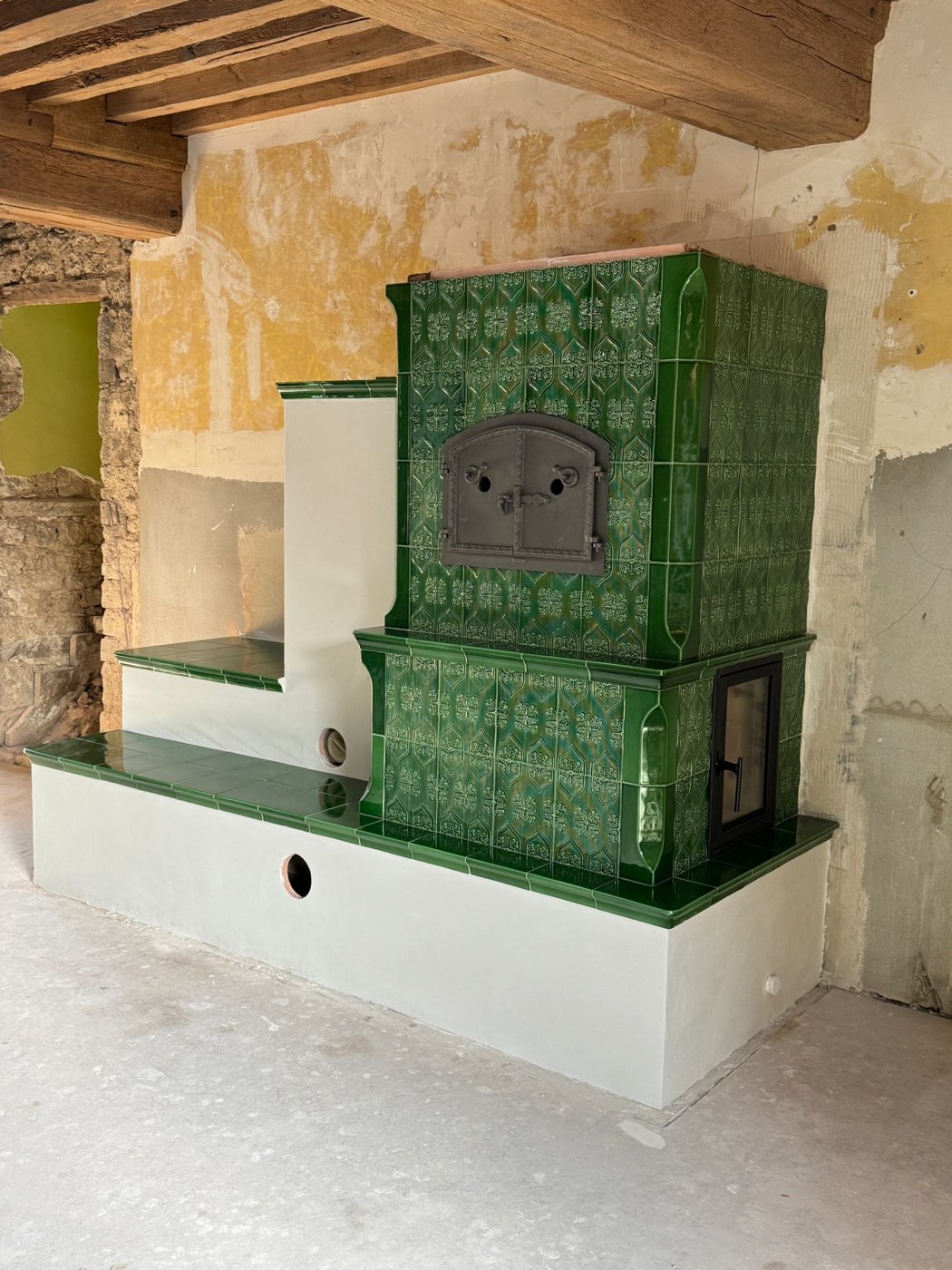
This principle changes everything: less wood burnt, fewer particles emitted, no overheating, and a stability of comfort that no convection appliance can match.
Key points — one short, lively burn, a refractory mass that stores the heat, a slow release as radiant heat: less wood, fewer emissions, more comfort.
How it is built, inside
The air inlet
Combustion air comes from outside through a dedicated duct. The house is not depressurised and the fire does not draw its air from the room.
The firebox
The wood burns fast and at high temperature in a firebrick chamber. A burn lasts one to two hours — that is short, and it is intended.
The rising channel
The smoke, very hot, rises first. That is where it gives up the most heat, and that is why the upper part of the heater warms up first.
The storage channels
Instead of heading straight for the flue, the smoke travels a long circuit of baffles. At each pass, the brick takes up the heat and the smoke cools.
The mass
One to several tonnes of material charged in a few hours, which then release heat by radiation. That is the whole principle, and the whole constraint: the floor has to bear it.
The outlet to the flue
The smoke leaves far colder than it entered: the heat has stayed in the heater. The flue is calculated (NF EN 13384-1) — without proper draught, nothing works.
Understanding, step by step
The masonry heater: what is it?
The definition, the principles, and what sets it apart from every other wood stove.
How does it work?
Lively combustion, storage in the mass, slow release: the complete cycle.
The different types
Grundofen, Kachelofen, Finnish kits, masonry cookers: the families and their uses.
Choosing your masonry heater
The criteria that matter: volume to heat, floor, flue, way of life.
Radiant heat
Why a warm surface heats differently — and better — than blown air.
Wood as fuel
The fuel: species, drying, storage, calorific value.
Wood combustion
What really happens in the firebox, from the burn to the embers.
Inspiration
A gallery of heat-storage stoves to feed your project.
Frequently asked questions
How long does a masonry heater heat after a burn?
A single hot fire is enough for the heater to release steady heat for eight to twenty-four hours — twelve to twenty-four, and sometimes more, on the heaviest site-built masonry heaters — thanks to the heat stored in its refractory mass. It does not heat hard, it heats long.
Does a masonry heater use a lot of wood?
No: the heat-storage principle reduces wood consumption compared with a conventional stove, while also reducing particle emissions. The fire is brief; afterwards, the mass gives back what it has stored without burning anything more.
What is the difference from a conventional wood stove?
A conventional stove heats the air as long as the fire burns. A masonry heater stores the energy of a brief fire in refractory materials (brick, stone), then releases it as radiant heat, gradually and evenly, long after the fire has gone out.
Is a masonry heater heavy? Does it need a reinforced floor?
Yes, it is a masonry structure that often weighs over a tonne. This is one of the points checked during the study: type of floor, any load transfer needed. On a concrete slab, it generally goes in without difficulty.
Who builds Thermasse heaters?
Each heater is sized by a design calculation, drawn in 3D, then built by hand by Thermasse, a company qualified in masonry and in sweeping and flue work, covered by ten-year liability insurance (assurance décennale, mandatory in France), and RGE (French ‘reconnu garant de l’environnement’ label) Qualibois certified, Air module. Guiom, founder of Thermasse, is a founding member of the AFPMA.
Imagine your made-to-measure masonry heater
Dreaming of a unique heater that combines tradition and modernity? Request a personalised study today.