
Radiant heat warms bodies and walls, not the air. The warmth feels like sunshine on the skin, with no hot air rising to the ceiling and no dust stirred up. A room heated this way feels comfortable at a lower air temperature.
Checked on 31/08/2026
Heating bodies, not air
There are two ways of heating a room. Convection heats the air, which rises, spreads out, and is lost every time a door opens: that is how radiators and cast-iron or steel stoves work. Radiant heat passes heat directly from a hot surface to the bodies and objects that ‘see’ it, without going through the air: that is how the sun works, and how a masonry heater works.
A warm mass of several square metres radiates continuously towards everything around it. Walls, furniture, floor and people warm up; the air, meanwhile, stays cooler and more stable.
What that changes in a room
- No stratification. Hot air from convection builds up under the ceiling and leaves feet cold. Radiant heat warms from top to bottom without distinction, and you feel comfortable at a lower air temperature.
- No draughts. Nothing blows, nothing circulates: no dust stirred up, no feeling of a draught.
- Warm walls. Once charged, the walls and floor give the heat back in turn; an open door does not empty the room of warmth all at once.
- Warmth that lasts. The mass goes on radiating long after the burn, with no flame and no noise.
Where a masonry heater’s radiant heat comes from
The heat of the fire is stored in the masonry during the burn, then given off by the surface of the cladding. That surface is large and warm — not scorching like the sheet metal of a steel stove — and it is this combination, large area and moderate temperature, that produces gentle, even radiant heat. The choice of cladding matters: stove tiles, stone and render do not give off heat at the same rate, and the calculation takes that into account.
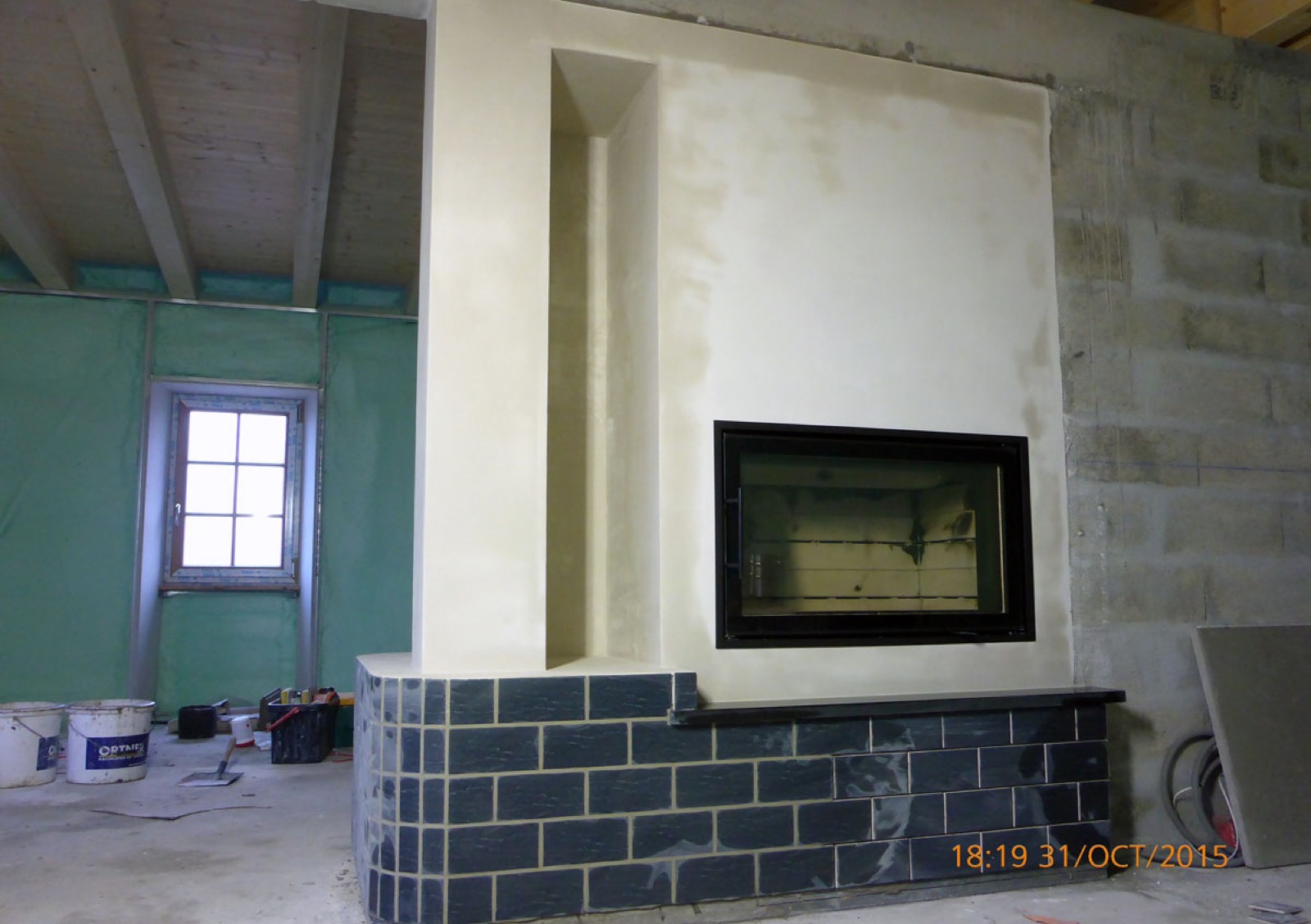
Where to put the heater to make the most of it
Radiant heat travels in straight lines: a masonry heater heats what it sees. So it goes at the centre of the home’s living space, or against a wall from which it takes in the whole room, rather than in a recess. A see-through heater, built into a partition, heats two rooms from the same fire; a heated bench puts the radiant heat within reach. Our projects show these layouts.
What radiant heat does not do
It does not heat a room closed off behind a door, nor a corridor out of sight. It does not warm a house in ten minutes: the mass has to charge first. In a house with many partitions, or for distant rooms, the masonry heater is the main heating backed by a supplementary source — something the study establishes, room by room.
Key point — Radiant heat warms bodies and walls, not just the air: even warmth, with no draughts and no dust stirred up.
Page reviewed on 31/08/2026 by Thermasse — stove builder and founding member of the AFPMA. These general principles of the site-built masonry heater are made specific, with figures to back them up, during your project study.