
A masonry heater is a site-built heating appliance whose material — firebrick, grog, stone — stores the heat of a short burn, then releases it as radiant heat for eight to twenty-four hours. It weighs from one to several tonnes and is built on site.
Checked on 31/08/2026
A mass that heats when the fire is out
A masonry heater is a heating appliance built on site, whose material — firebrick, grog, stone — takes in the heat of a short fire and then gives it back for hours. Grog is clay that has been fired and then crushed, reused as a refractory material: it withstands direct flame and holds heat. This ability of the material to store heat and then release it is what we call thermal inertia.
The principle has three stages. A brisk burn, lasting one to two hours, brings the firebox to a high temperature. Instead of going straight to the flue, the flue gases travel through a circuit of channels in the masonry and give up their heat to it. Then the mass radiates, slowly: from eight to twenty-four hours depending on the appliance and the house, twelve to twenty-four — and sometimes more — on the heaviest site-built masonry heaters. During all that time, no fire is burning. That is the principle to remember: a masonry heater does not heat hard, it heats for a long time; the fire is intense and brief, the heat is spread out.
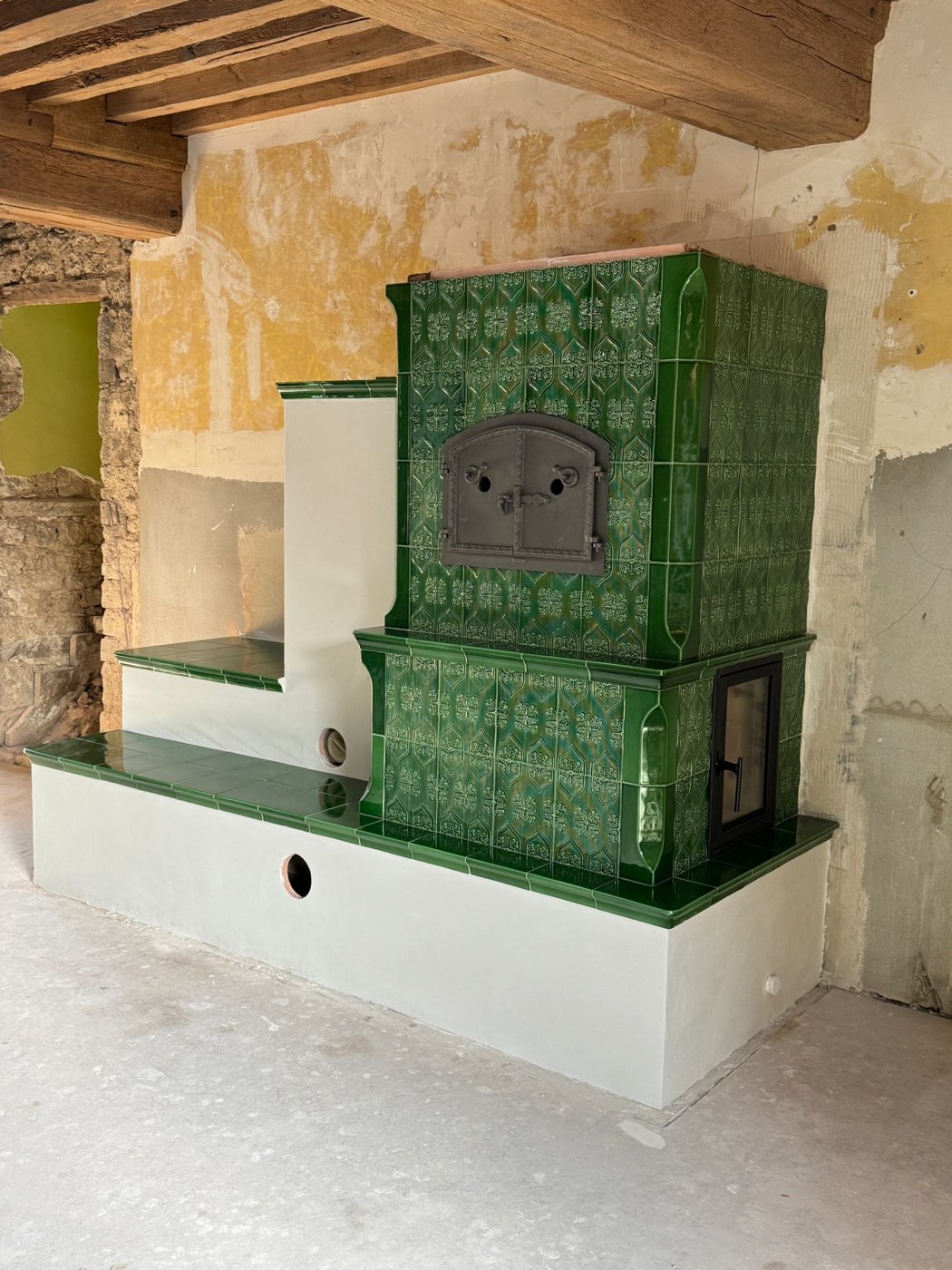
How it differs from a wood stove
A cast-iron or steel wood stove heats the air, as long as the fire burns. You reload it every hour or two, you turn it down low in the evening, and the room cools as soon as the fire goes out. A masonry heater works the other way round: a full fire, never damped down, then nothing. You do not reload it; you wait for the next burn, the following morning or evening.
Three consequences for the house:
- Less wood. A brisk, complete combustion draws more energy from each log than a smothered fire; and the heat that, in a conventional stove, went up the flue stays here in the mass.
- Fewer emissions. A high-temperature fire burns off the gases and particles that a damped-down fire lets escape.
- A different kind of heat. The mass heats by radiation: it warms bodies and walls, not the air. The sensation is that of sun on the skin, with no hot air rising to the ceiling and no dust stirred up. The page on radiant heat details the effects.
What it is made of
- The firebox, in firebricks, where the wood burns fast and hot. Depending on the appliance, it is either fully built in masonry or built around a manufacturer’s firebox, with or without glass.
- The accumulator, that is, the circuit of channels through which the flue gases pass before reaching the flue. Its length and cross-section are calculated so that the gases come out far cooler than they went in.
- The cladding, in stove tiles, render, stone or exposed brick. It contributes to the thermal inertia and evens out the surface temperature: a masonry heater can be touched; it does not burn.
- The flue, which provides the draught — the suction that keeps air and flue gases moving. Without proper draught, no heater works; the flue is calculated just as the appliance is.
What to know before wanting one
A masonry heater weighs from one to several tonnes. On a slab, it goes in without difficulty; on a suspended floor, the load-bearing capacity is checked before any drawing. It needs space, a suitable flue, and an external combustion air supply in an airtight house.
It also needs a rhythm: one burn a day, or one every two days in the shoulder seasons. It will not warm a room in ten minutes, and it is not controlled by a thermostat. In return, it never really goes out: the house is warm when you wake, and the evening fire lasts the night.
Where it comes from
Site-built heat-storage heaters have existed for centuries in the cold countries of Europe: the tiled Kachelofen of Austria and Germany, the brick Grundofen, the Finnish, Swedish and Russian stoves. Alsace has kept the tradition. Today’s appliances take up the same principle, with a standardised sizing calculation (NF EN 15544) and glazed fireboxes. The page on the types of masonry heater presents these families.
Key point — A site-built masonry heater that stores the heat of a short burn and releases it gently for eight to twenty-four hours: more comfort, less wood.
Page reviewed on 31/08/2026 by Thermasse — stove builder and founding member of the AFPMA. These general principles of the site-built masonry heater are set out in detail, with figures, during the study of your project.