A couple of city dwellers wanting to live in harmony with nature settled in the heart of the Morvan regional nature park, at Larochemillay. These friendly newcomers to country life have set up a smallholding to feed their young family.
The oil-fired heating in their house was a long way from matching their ecological convictions. So they went looking for a clean, economical way to heat, and the masonry heater was the obvious choice.
Like all our customers, they filled in the contact form on our website, the starting point of the adventure.
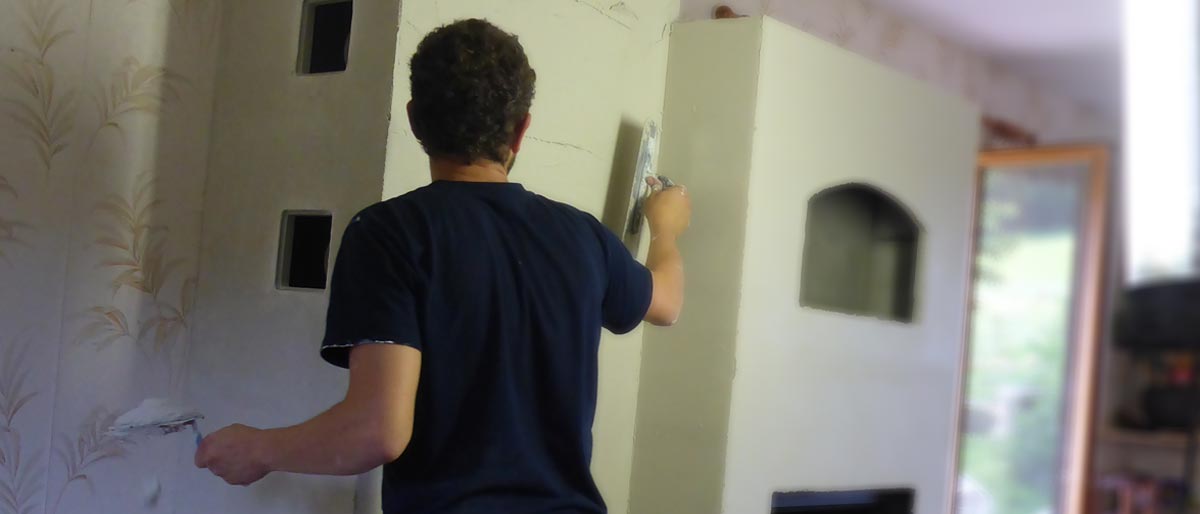
This 1970s/80s house, with a semi-basement and an upper floor, was not originally designed to take a masonry heater. But our customers made a few concessions, agreeing to remove some partitions to help the heater’s radiant heat spread. After reinforcing the concrete beam in the basement, we set to work. We lined the existing chimney’s clay flue block (with a 200 mm diameter instead of 180, as the flue was short). The heater core was then clad in refractory slabs and a finishing render was applied.
Our customers chose to build a warming niche into their heater, which will give a ‘warm’ welcome to dishes simmered with produce from the garden.
What a pleasant way of life lies ahead!
The masonry heater as seen by our customers:In our part of the world, the need to keep warm is as vital as the need to eat. So we approached the question with the same care, aiming to be self-sufficient locally and to generate no waste or pollution. Needless to say, the oil boiler installed in our house does not go in that direction. On the other hand, turning our house into a passive house did not seem feasible to us, even though it is the best solution (the cleanest energy is of course the energy you do not use). We chose the solution that seemed best suited to our situation: the masonry heater.
Burn in the masonry heater
What is a masonry heater?
It is a wood-burning stove — logs in our case — of the ‘heat-storage’ type, whose basic principle is well known in Alsace and the German-speaking countries under the name ‘Kachelofen’. Unlike a standard wood stove (an ‘insert’), the masonry heater is made of heavy refractory materials (in our case, weighing over a tonne).
The masonry heater is a long-term investment, since it becomes the house’s central heating. It frees you for good from fossil fuels and nuclear power for heating. It also offers high resilience, as it is independent of any electrical system. Finally, it brings great comfort, acting like a ‘sun’ inside the house.How does the masonry heater work?
The heater’s mass lets it store the heat given off during the burn and then release it slowly for more than 24 hours. This is heating by ‘radiant heat’, as opposed to ‘convection’, which only heats the air. With a single burn a day, the heat stored in the masonry heater is released until the next day. In colder weather, one burn in the morning and another in the evening are enough to keep a good temperature throughout the house. With this method, the permaculture principle ‘Catch and store energy’ is respected.
Building the heater
We called on Guiom, of the company Thermasse, to design and install the heater. It all begins with a simulation that takes into account all the dimensions and constraints of the house. As you can see in the photo, a long duct made of very heavy ‘modules’ leaves the firebox and then winds its way round before joining the chimney. This is one of the secrets of this heater’s high energy performance, since it ‘holds back’ as much heat as possible along the whole path before it is lost up the chimney.
Simulation of the masonry heater
The part of the heater that will remain visible is the combustion chamber, which on its own weighs 560 kg. The glass is not essential (the traditional ‘Kachlofen’ had none) but it lets a little heat spread immediately near the heater, by convection, a small departure from the pure radiant-heat principle.
Combustion chamber under construction
The ‘KMS modules’ (for ‘Keramik Modul Speicher’) are a speciality of the Austrian manufacturer Ortner, assembled to measure according to the architecture of the house, aesthetic wishes and technical constraints (total length, draught, etc.).
Assembling the KMS modules
The heater is then fully clad in slabs made from refractory clays and grog. It takes on its final appearance after the application of a mineral mortar that can withstand temperatures of up to 1,000°C.
The unit, in pictures
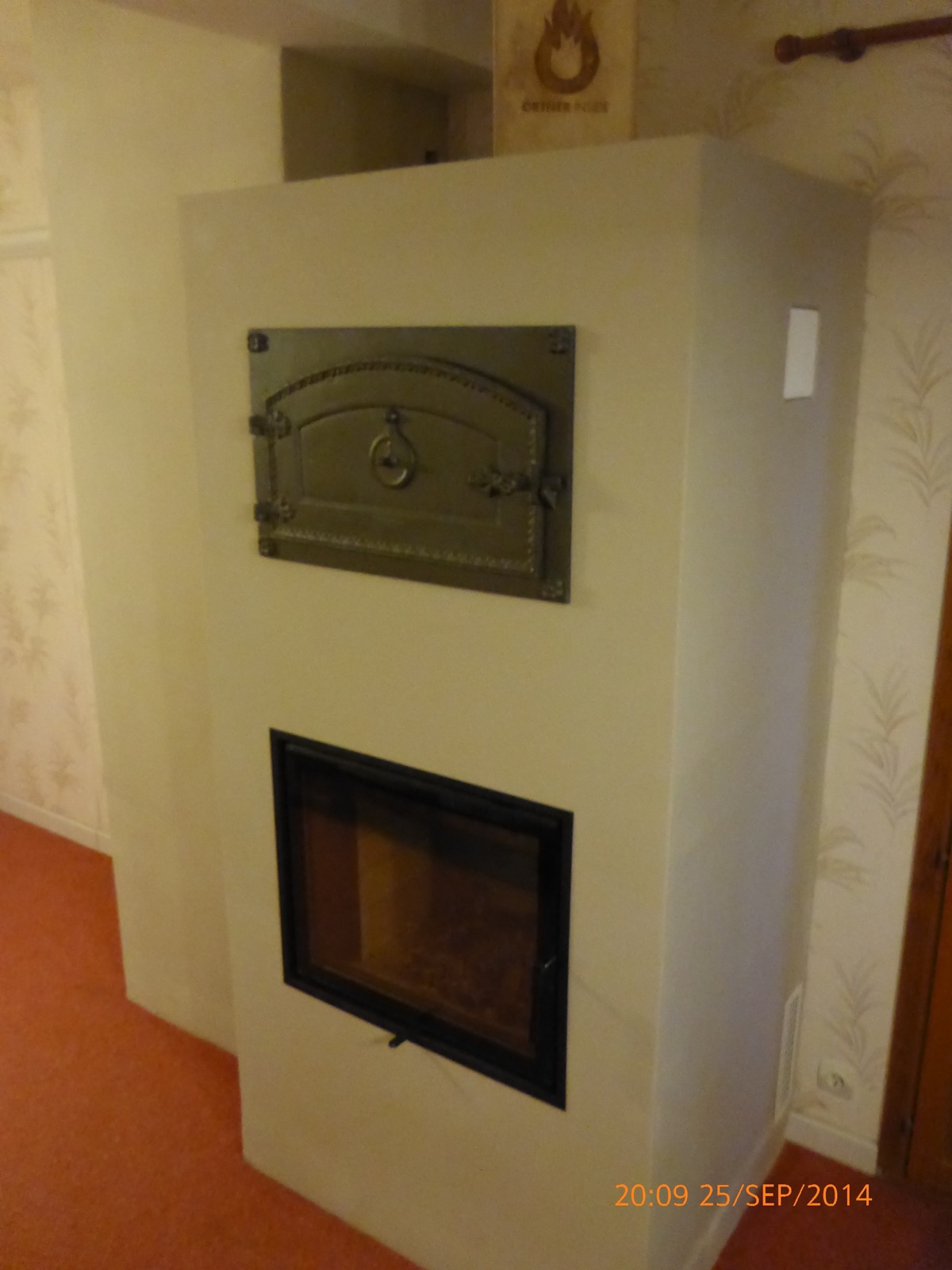
The finished unit: two openings one above the other, nothing else. The mass holds the corner of the room.
Everything hinges on the two openings, one above the other. At the bottom, the glazed firebox; above it, a cast-iron oven door closing the baking chamber — which recovers the heat of the flue gases as they leave the firebox, where it is highest, before they go back down into the mass.
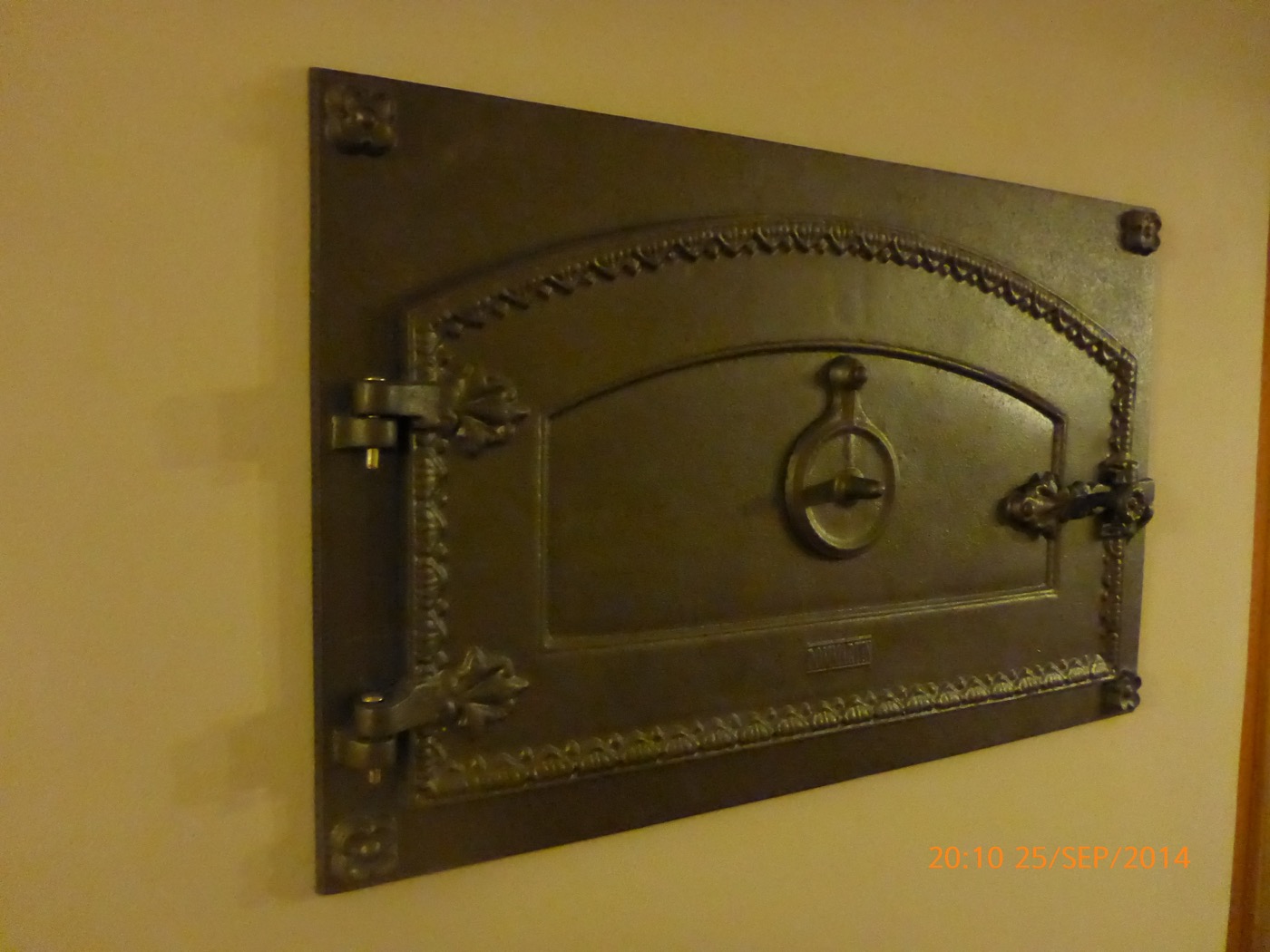
Cast iron, beaded moulding and corner rosettes: the oven door, up close.
The door deserves a closer look: a piece of cast iron, with a rectangular plate, framed by a beaded moulding and corner rosettes, closed by a swivelling ring handle. This kind of door is chosen to match a new unit to the character of an old house.
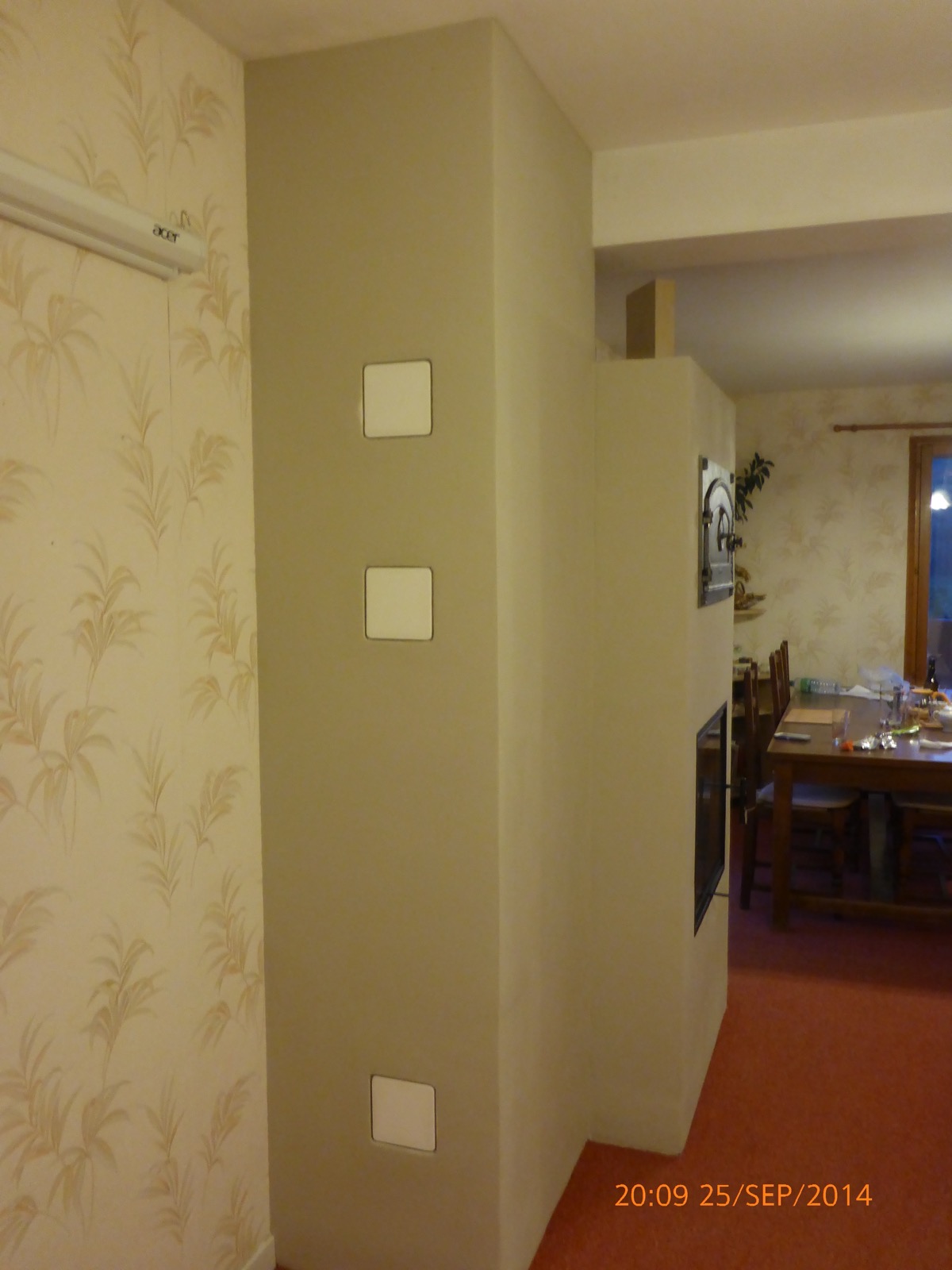
The three cleaning doors, lined up on the side face — one for each bend in the circuit.
To provide the best experiences, we use technologies like cookies to store and/or access device information. Consenting to these technologies will allow us to process data such as browsing behavior or unique IDs on this site. Not consenting or withdrawing consent, may adversely affect certain features and functions.
Functional
Always active
The technical storage or access is strictly necessary for the legitimate purpose of enabling the use of a specific service explicitly requested by the subscriber or user, or for the sole purpose of carrying out the transmission of a communication over an electronic communications network.
Preferences
The technical storage or access is necessary for the legitimate purpose of storing preferences that are not requested by the subscriber or user.
Statistics
The technical storage or access that is used exclusively for statistical purposes.The technical storage or access that is used exclusively for anonymous statistical purposes. Without a subpoena, voluntary compliance on the part of your Internet Service Provider, or additional records from a third party, information stored or retrieved for this purpose alone cannot usually be used to identify you.
Marketing
The technical storage or access is required to create user profiles to send advertising, or to track the user on a website or across several websites for similar marketing purposes.