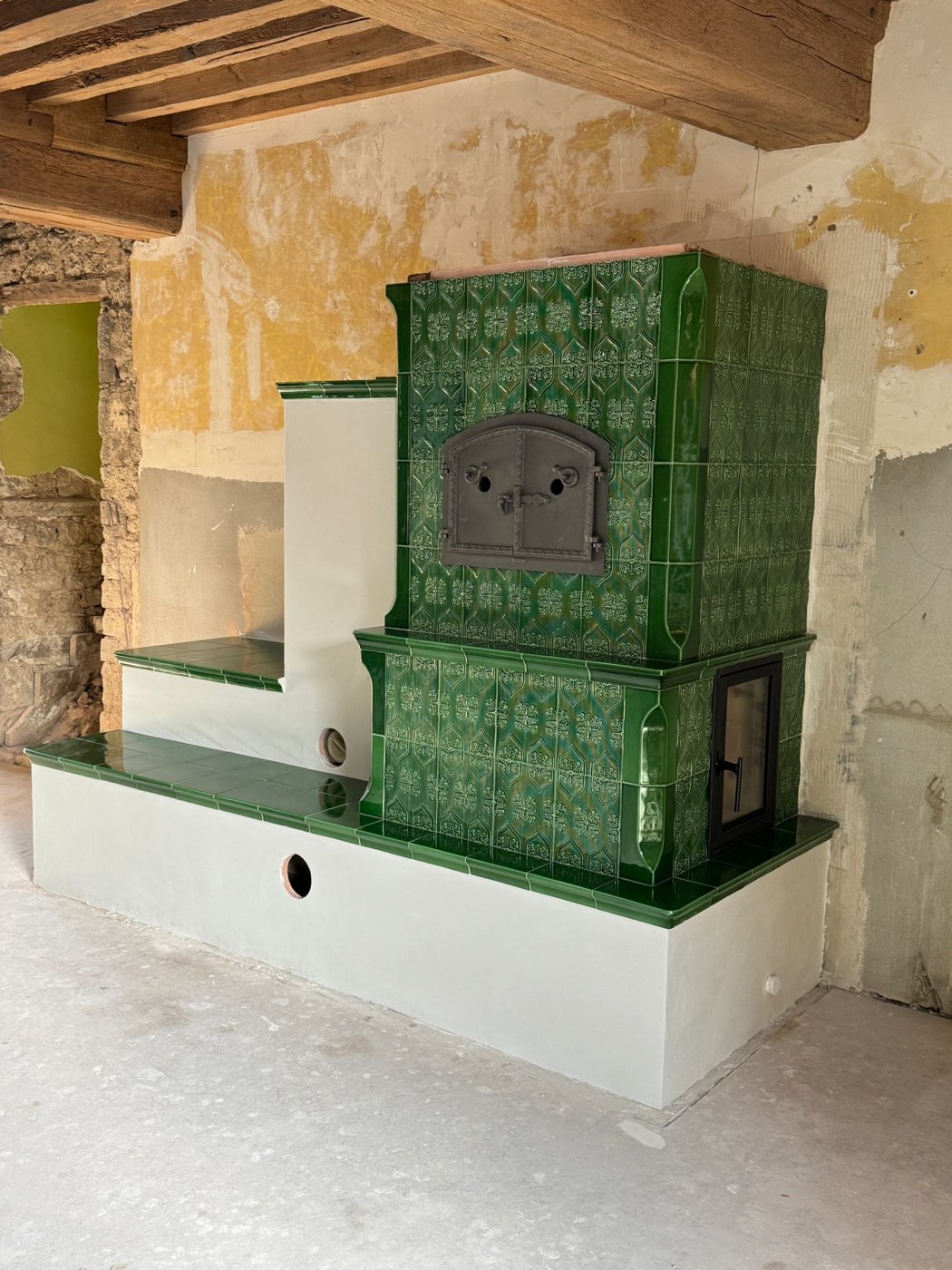

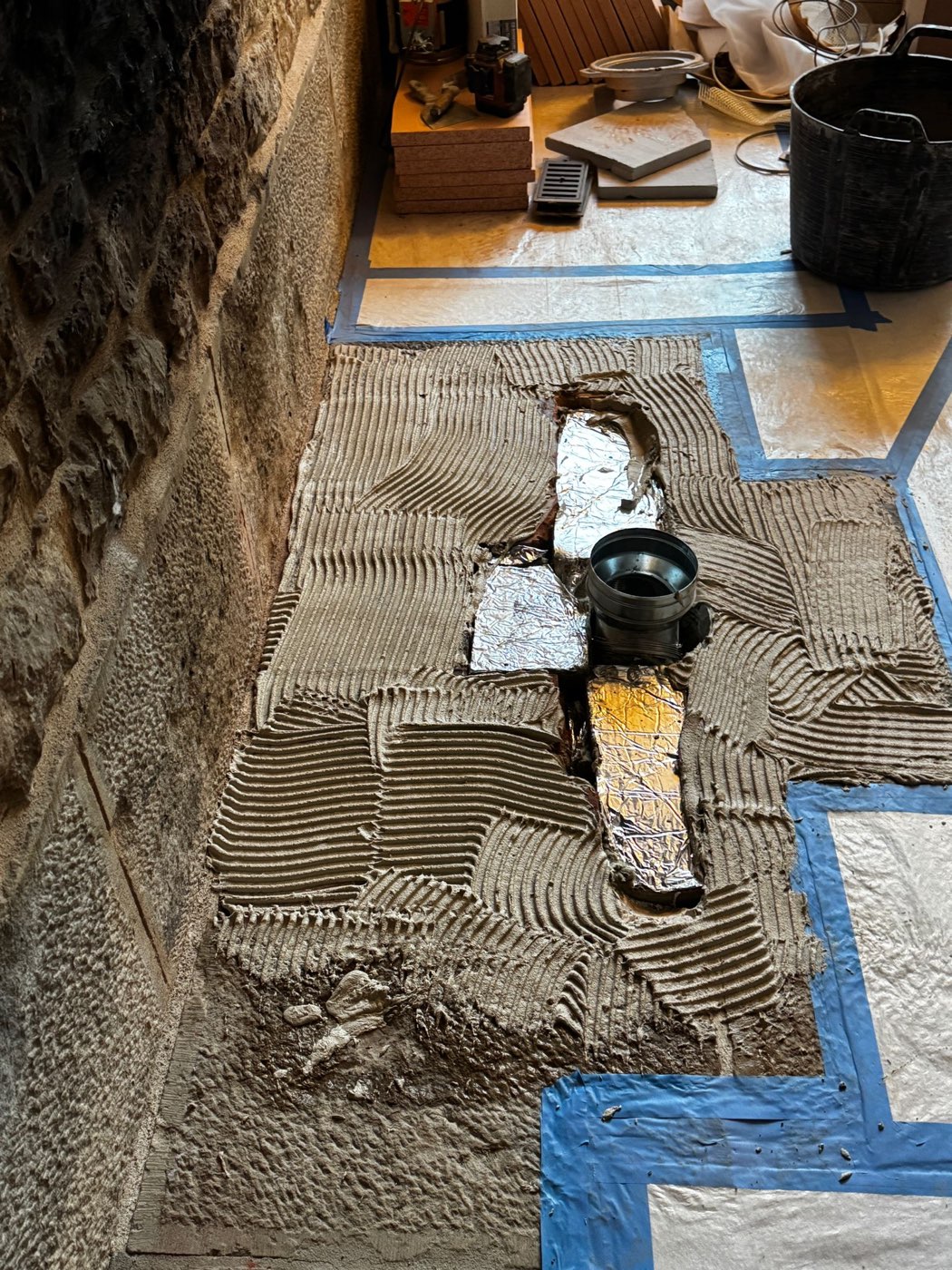
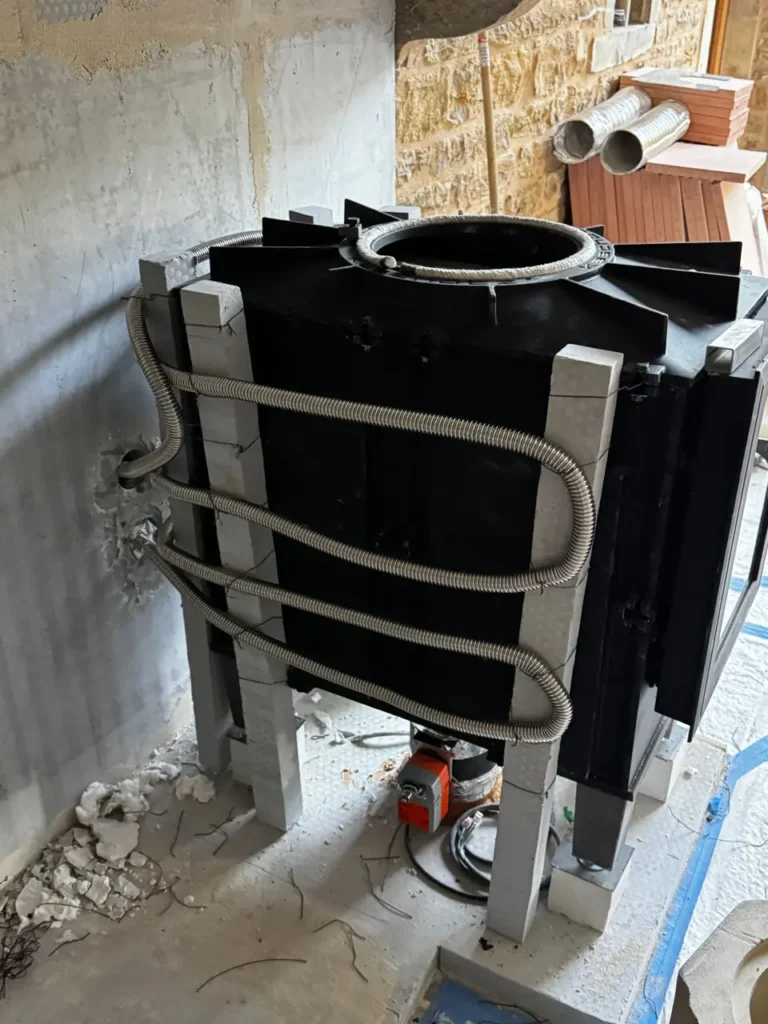
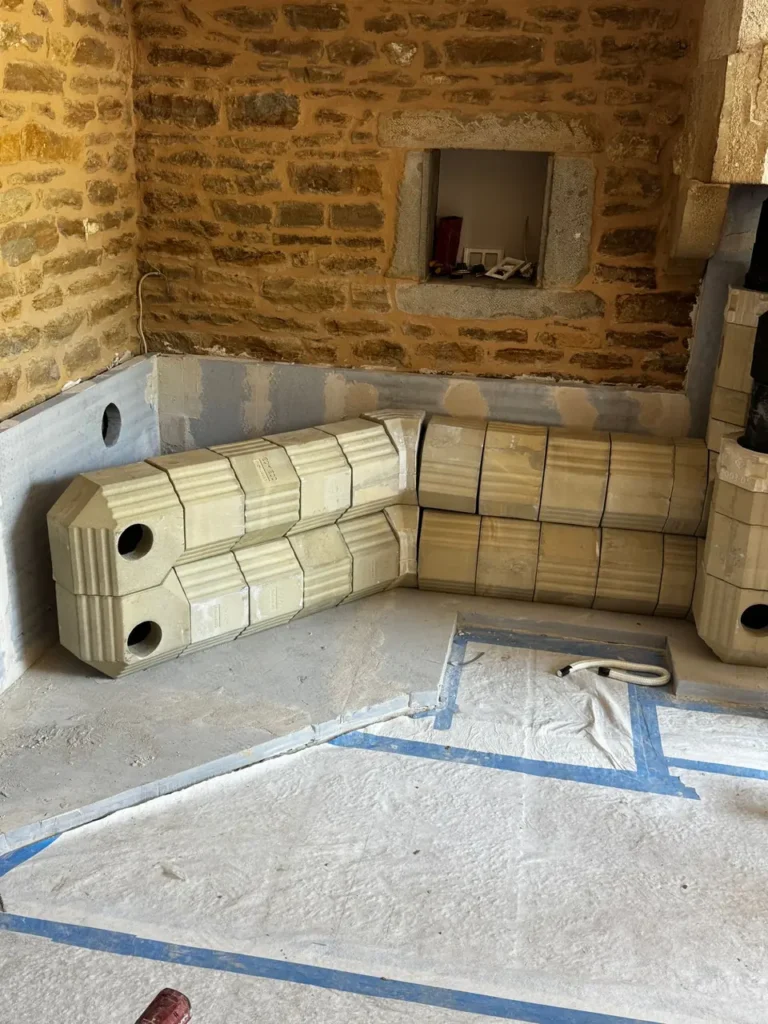
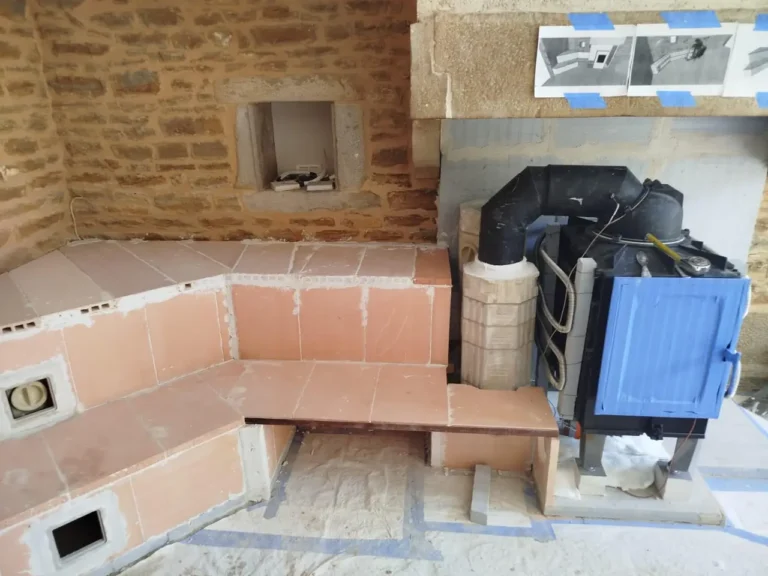
An old stone fireplace, at Joncy (Saône-et-Loire), turned into a bespoke masonry heater. The original lintel and corbels stay in place: the heater sits in the hearth, and its heated bench runs along both walls. Here is how we designed and built it.
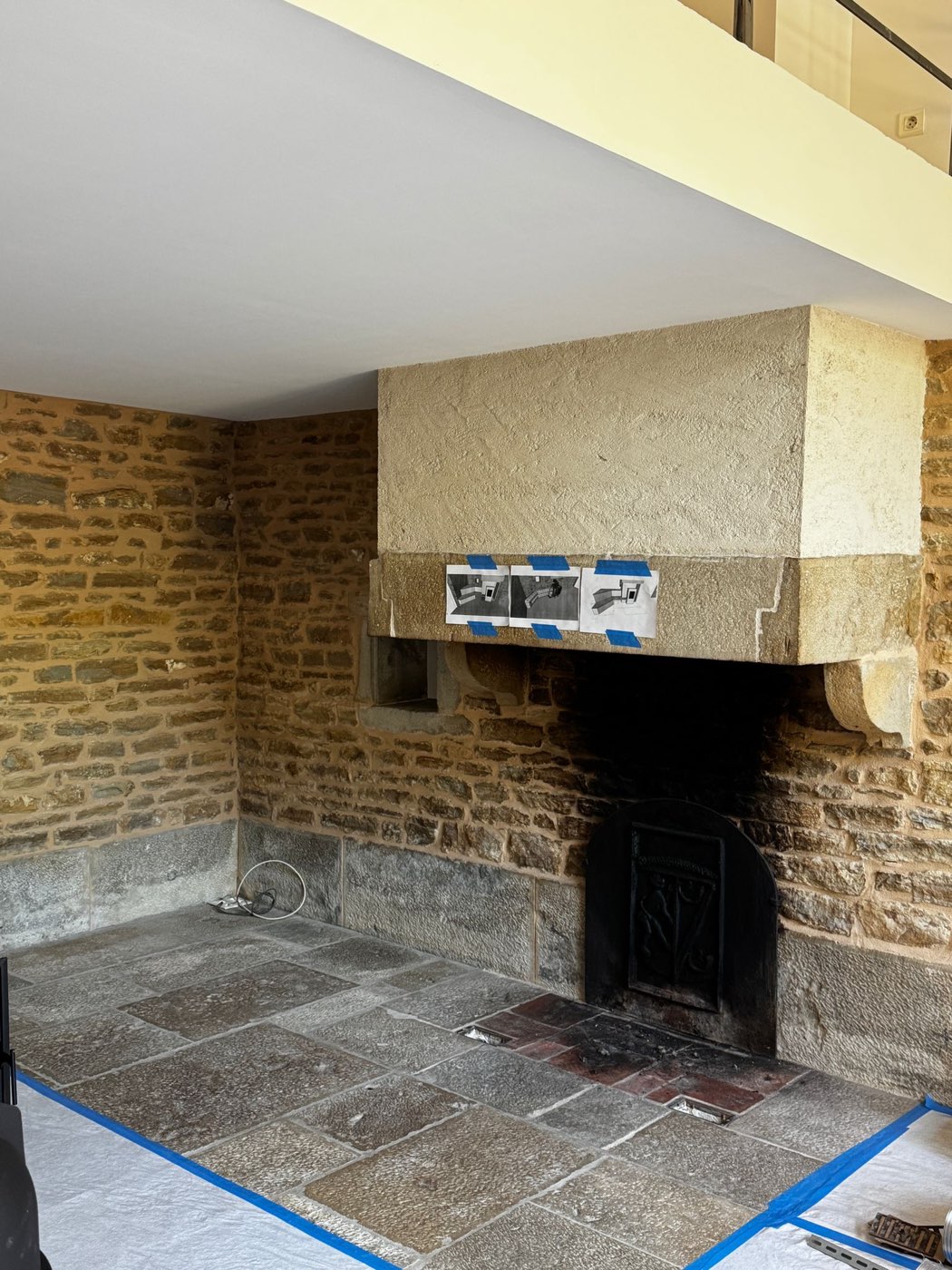
Keeping the old fireplace, giving it a new role
An open fireplace heats poorly. The fire burns fast, and much of the heat goes back up the flue along with the room air. Yet this old, renovated house had what is needed for proper wood heating: a wide hearth and an existing flue.
Rather than demolish, we kept what gives the room its character — the stone lintel and its corbels — and built the heater within the footprint of the hearth. The old fireplace becomes the envelope of the masonry heater. The fire now burns in a closed firebox, and its heat is stored instead of escaping.
Sizing before drawing
A masonry heater is sized on the needs of the house, not on the size of the old fireplace. The design calculation, based on the data supplied for this pre-1975 house at 240 m above sea level, puts the heat losses at around 8 kW. The heater is designed to standards EN 15544, which governs the sizing of site-built heat-storage heaters, and EN 13384, which covers flue calculation.
Then come the drawings: wall insulation, bench footprint, niches, air supply. Every cladding element is dimensioned before assembly begins. To understand why the mass matters more than the flame, see how a masonry heater works.
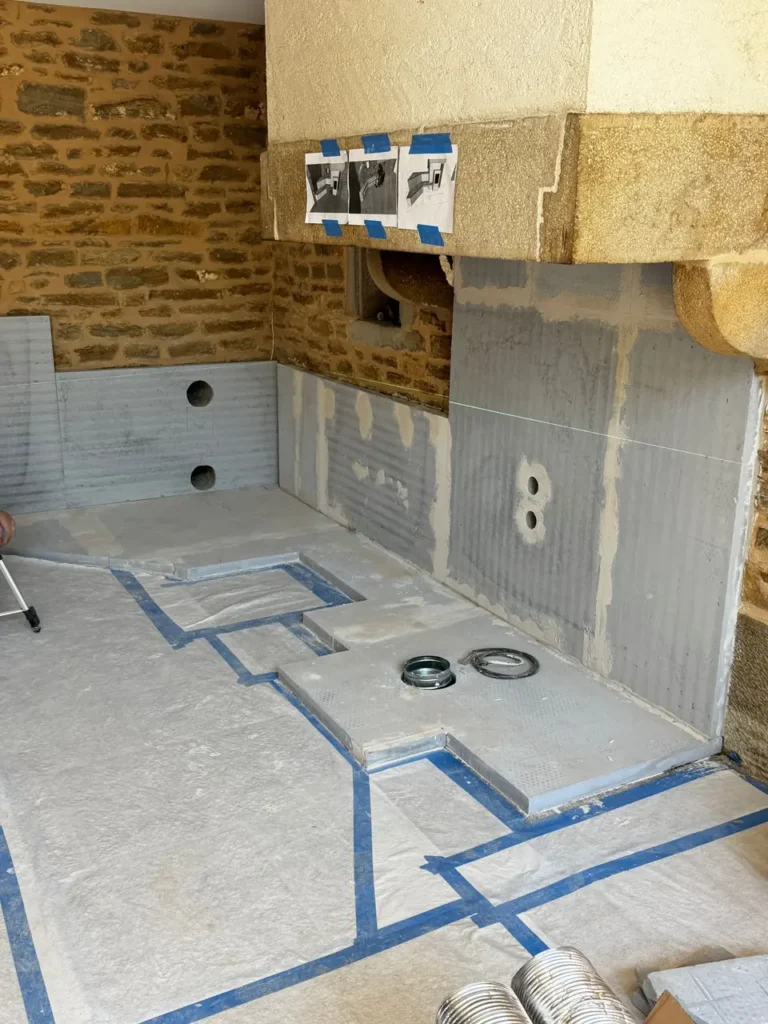
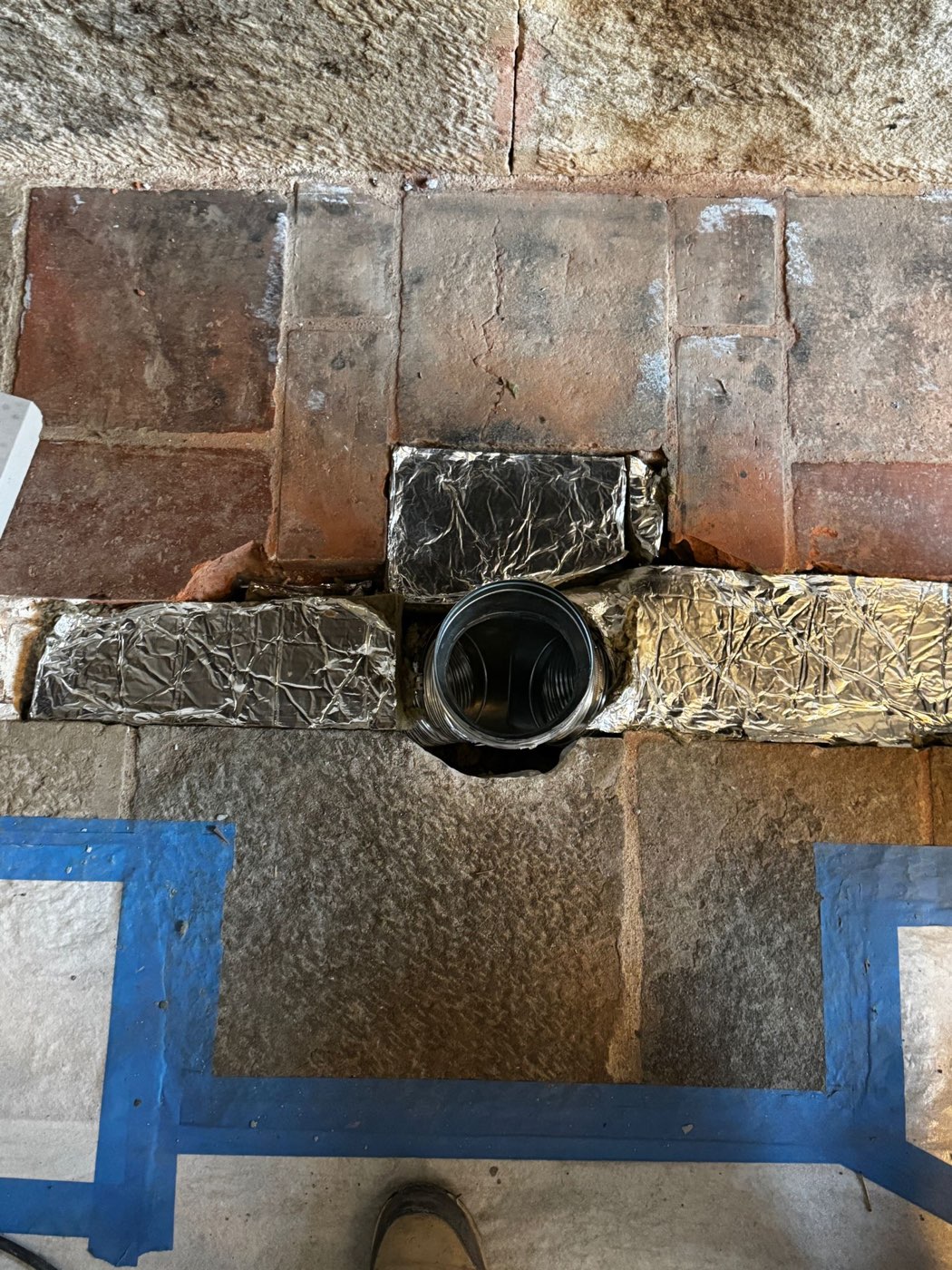
The heater is airtight. Combustion air comes from outside through a duct that passes through the old masonry and opens beneath the firebox: the fire does not consume room air, which matters in a house fitted with mechanical ventilation (VMC).
The core: a cast-iron firebox with controlled combustion
The firebox is a cast-iron Eurotherm 12 Automatique, designed for heat-storage stoves: air injection at several points, electronic combustion control, Wi-Fi operation. It takes 7.5 to 20 kg of wood per burn. The electronics meter the air over the course of the burn; the option of an end-of-circuit damper was not taken up. The two approaches are compared on our page about regulating a masonry heater.
Around the firebox, a passive stainless-steel tube exchanger is provided to preheat domestic hot water, by indirect recovery and with no contact with the flames. The principle is explained on the hydraulic heat exchangers page of our Cœur de Foyer shop.
The heated bench, module by module
Leaving the firebox, the flue gases enter a heat store made of interlocking ceramic modules. The path rises, turns horizontal, then runs the full length of the corner bench before reaching the flue. This journey turns the heat of the flue gases into stored heat: the ceramic absorbs it during the burn, then releases it slowly as radiant heat.
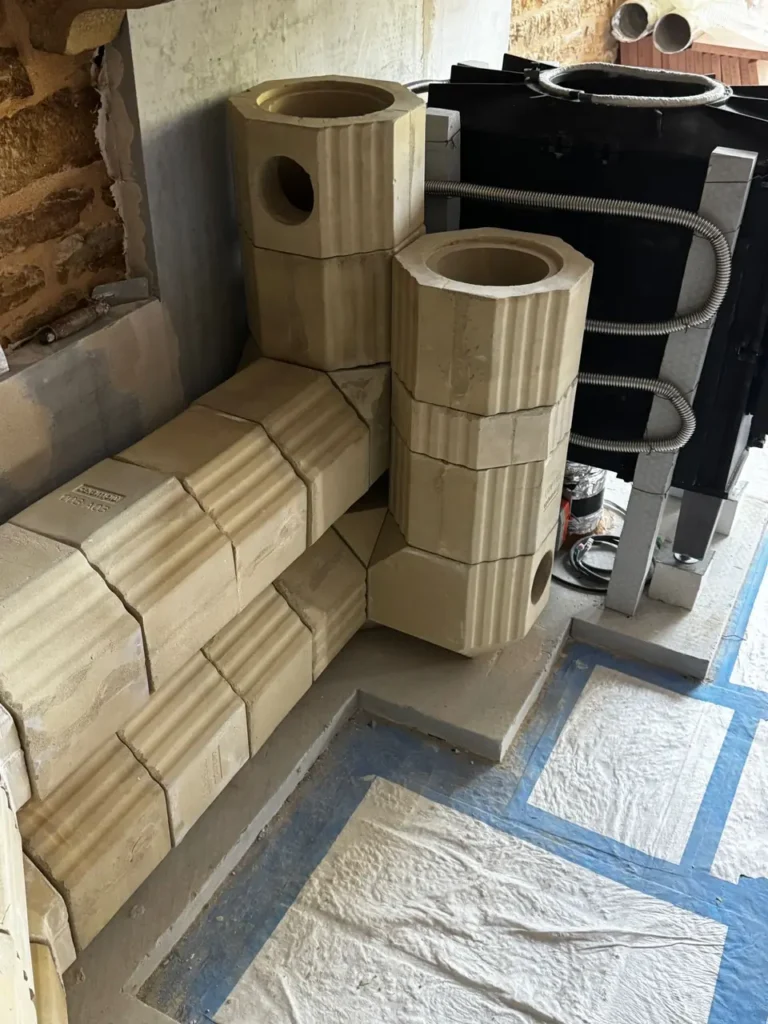
The whole is then clad with refractory slabs, then rendered. Two niches are built into the cladding: a plate-warmer above the firebox, closed by a double-leaf grille, and a tall log niche beside it.
Inside the old fireplace flue: liner and insulation
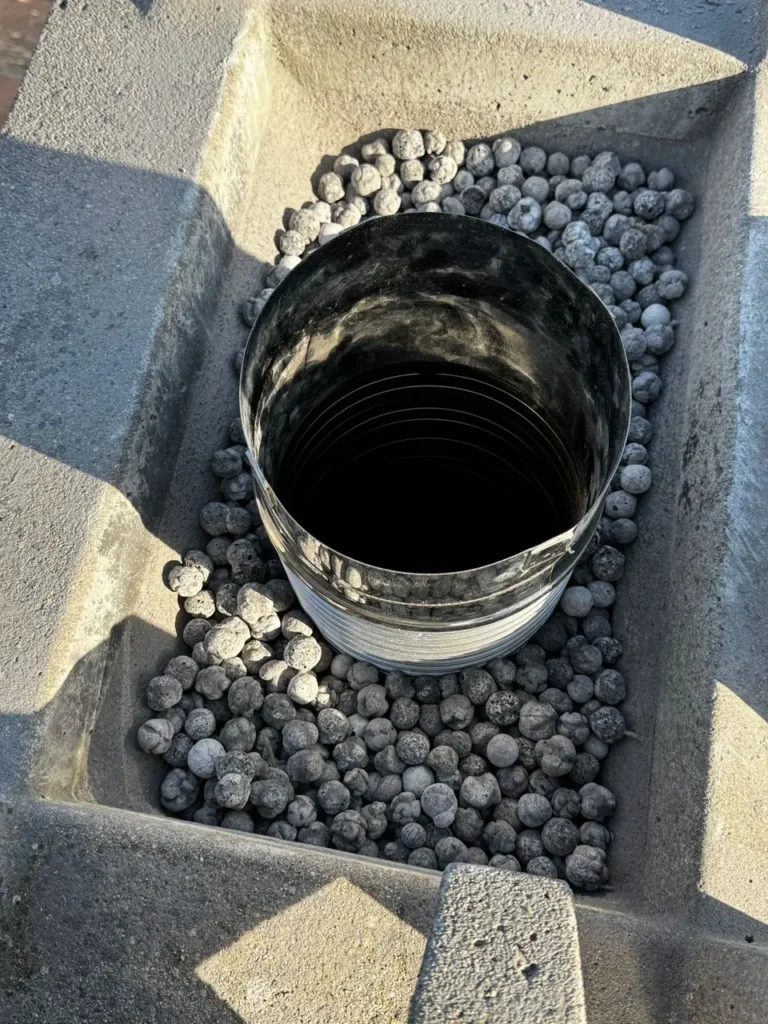
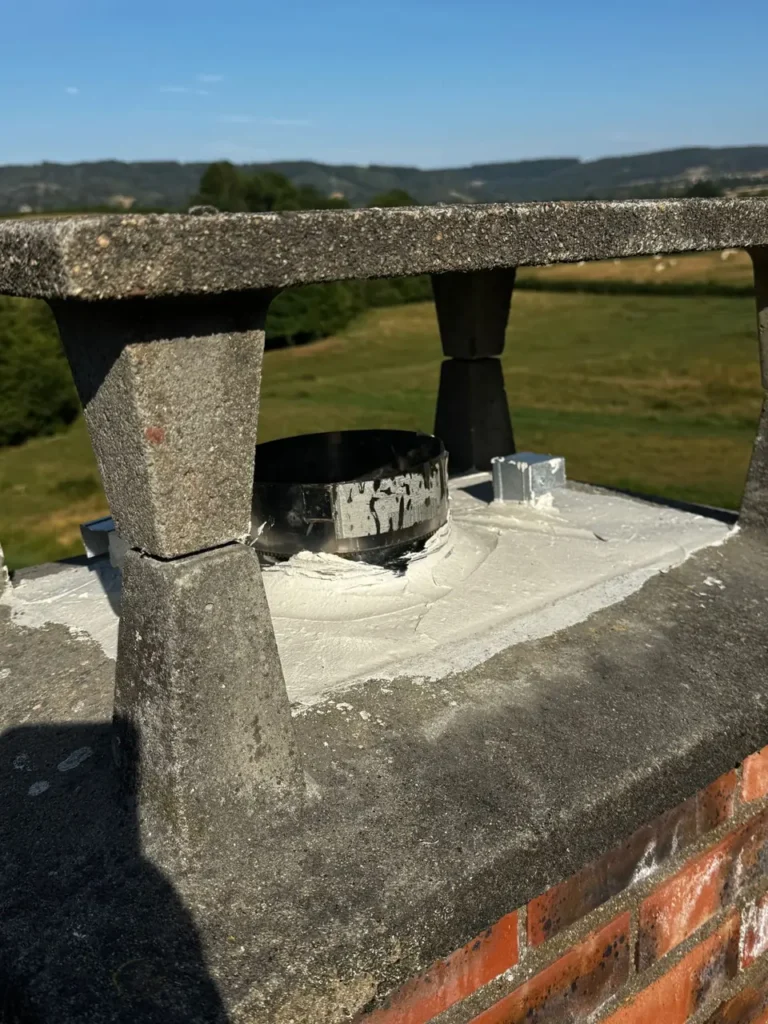
The original flue is not used as it is. It receives a Ø 180 mm twin-wall stainless-steel flue liner, and the space between the liner and the masonry is filled with loose-fill insulation. The open fireplace is sealed airtight at the bottom to hold this insulation in.
The result, and what remains to be fitted
Pale render, straight lines, glazed firebox beneath the stone lintel: the masonry heater fits into the old fireplace without erasing it. The bench follows the two stone walls up to the heater, and the log niche keeps the wood within reach.
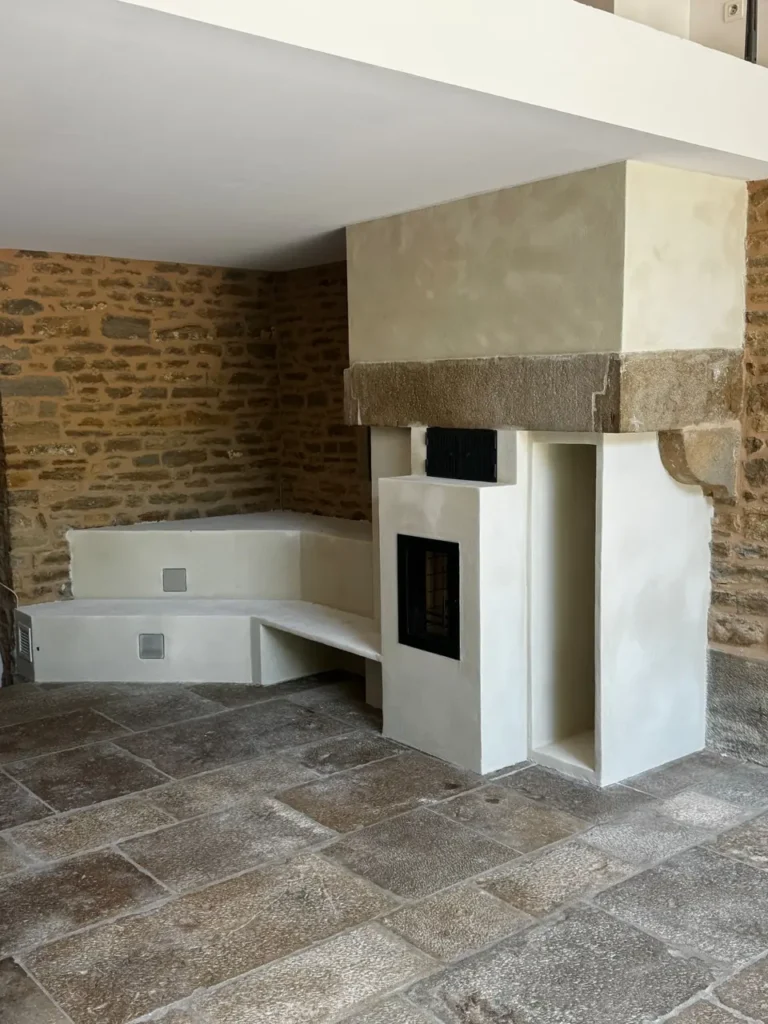
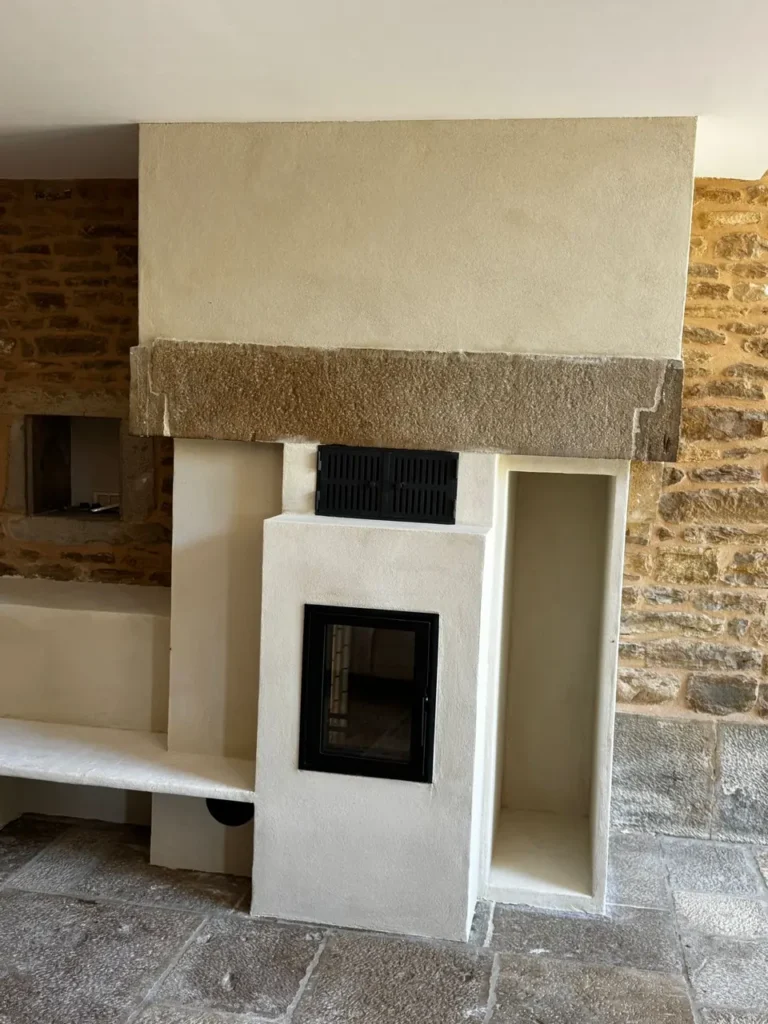
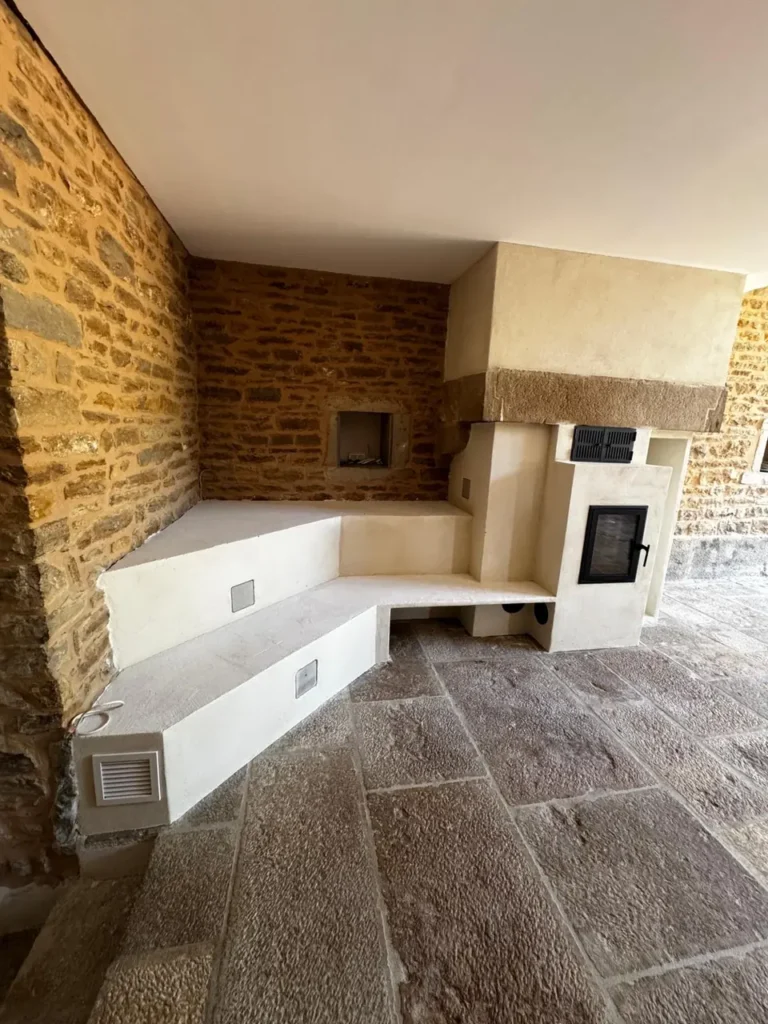
One last stage is still to come: the dressed-stone bench seats, entrusted to a stonemason, and with them the LED strip built into the bench. The opening image of this page shows the work once these seats are in place.
Key points — An old fireplace can house a masonry heater without losing its character: keep the stone, line and insulate the flue, bring in air from outside, and size the heater on the needs of the house, not on the size of the hearth.
Other projects follow the same logic. Also in Saône-et-Loire, at Viré, an insert becomes a masonry heater. In the Cher, the heater takes its place in the fireplace opening. Do you have an open fireplace and a house to heat? Request a study of your project.